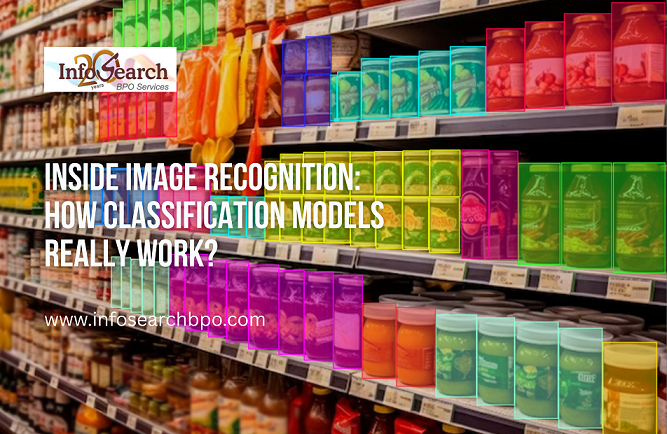
Infosearch provides the best image classification services for image recognition and image processing.
The power of image classification models can be seen when you take a picture on your phone, and it immediately informs you whether it is a cat, a sunset or a pizza. But what is really going on in these AI? We had better peep behind the curtain.
The Objective of Image Classification
Simply put, image classification refers to labeling (e.g., a dog, a car, a tumor, a defective product) of an image according to its contents. It is one of the most basic computer vision tasks, the foundation of such applications as:
- Medical diagnosis (finding disease in scans)
- Automatic driving (reading traffic lights and people)
- Retail (product searching by sight)
- Facial recognition security
The Data: Images and Labels
An AI model must be trained on the examples before it can perform the classification of images. This occurs by use of training datasets, that are:
- Input: Thousands (or millions) of pictures.
- Output labels: The ground truth (e.g., this is a cat, this is a dog).
To give an example, the well-known ImageNet dataset has more than 14 million labeled images and has 20,000+ categories, and this dataset has been instrumental in the development of computer vision research.
Neural Networks Architecture
The majority of classification of images in the modern world is based on deep learning, namely, Convolutional Neural Networks (CNNs). Here’s how they work:
- Convolution Layers
o Like scanners on an image.
o Simple features (edges, textures), then more complex ones (eyes, wheels, leaves).
- Pooling Layers
o Compress image image size whilst preserving important characteristics.
o Brings the model closer to real-life.
- Fully Connected Layers
o Take a combination of extracted features and classify by probability in each of the possible classes.
- Softmax Output
o Transforms the probabilities into a single final label: e.g. 90 percent dog, 7 percent cat, 3 percent horse.
The Learning Process
- When training, the model makes a prediction on the class of an image, and estimates it against the actual label:
- Loss Function: This is a measure of the wrongness of the guess.
- Backpropagation- Sends error signals in a backward direction through the network.
- Optimization (Gradient Descent): Optimises the weights of the network in order to obtain better accuracy.
This cycle is repeated millions of times till the model is quite good at predicting labels.
Real-World Performance
- Modern models of image classification can achieve a accuracy of more than 95 percent on benchmark data.
- More advanced and recent models such as ResNet, EfficientNet, and Vision Transformers (ViTs) are up to date in 2026.
- Models trained on sufficient data can be better at certain human tasks with fine-tuning, such as in medical imaging, artificial intelligence has been equivalent or superior to radiologists in the task of detecting lung cancer in CT scans.
Challenges
Even mighty models do not have no boundaries:
- Bias: When training data is not diverse, model can not work in real-life problems.
- Adversarial examples: The slightest change of pixels can confuse AI to the wrong classification.
- Calculate cost: Deep model training is expensive in terms of huge GPU resources.
- Explainability: Models may be a black box, in which case, it is difficult to justify predictions.
The Future of Image Classification.
Trends shaping the next wave:
- Self-supervised learning: Models which learn on unlabeled data, avoiding the expense of expensive annotation.
- Multimodal AI: Image-text combinations (e.g. show me a dog chasing a ball).
- On-device inference: Running models on edge devices (phones, cameras) with low-latency, real-time, and private applications.
Conclusion
The image classification models may have been thought of as magic because they can recognize what is in a photograph and that they can do this with a single press of a button, yet what is going on behind the scenes is a well-contrived system of data, mathematical algorithms and computer processing. These models are becoming not only correct, but essential, as they keep on evolving, building industries in healthcare, retail, and even smarter than ever automation.
Outsource your image classification, image recognition and image processing services to Infosearch, to train your machine learning models.




Recent Comments