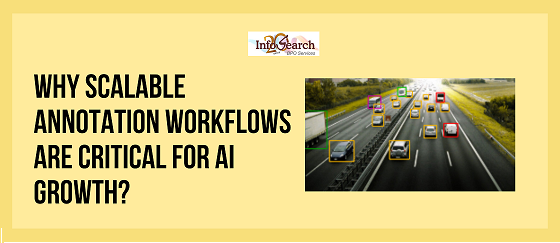
The level of intelligence of artificial intelligence is limited to the information it is taught. Behind all correct recommendation engines, self-driving systems, or intelligent chatbots, there is one critical basis: high-quality annotated data.
However, with the increasingly complicated AI platforms and the subsequent explosion in the volume of data, the old methods of labeling soon disintegrate. Here scalable annotation workflows can be mission-critical. AI innovation cannot keep up without the capability to label data in an efficient, consistent, and large-scale way.
Big Data Is the Engine of AI Growth — And a Lot of It.
Contemporary AI systems and particularly those dealing with computer vision and natural language processing demand large volumes of data to have high accuracy. Millions–billions of labeled data points are we are speaking of.
With the expansion of organizations with AI initiatives, they encounter:
- Increasing data volume
- More complicated annotation specifications.
- Quickening model iteration cycles.
This level of demand cannot be served using manual, ad-hoc labeling processes. Scalable workflows will make annotation operations increase in the same direction with AI ambitions.
What Is a Scalable Annotation Workflow?
Scalable annotation workflow is a technological-based system that is organized and managed to label large data effectively. It typically includes:
- Distribution systems of large, distributed teams.
- Annotation systems that have quality checks.
- Labeling and repetitive processes can be automated and assisted by AI.
- Guidelines and version control that is deployed successfully.
Rather than labelling as a bottleneck, it becomes a lean production process, which can be increased accordingly.
Eliminating Bottlenecks in Model Development.
AI development is iterative. Teams also train a model, test it, and identify gaps and this requires more labeled data to perform better.
Using no scalable annotation:
- Data queues pile up
- Model updates are delayed
- Time-to-market increases
The scalable workflows mean that new labeled datasets can be generated in a short time, which can be retrained and improved faster with the help of models. This ensures innovation process is first mover rather than a standstill process.
Sustaining Quality at Scale.
Annotating on a large scale is not only a matter of speed, but also accuracy as one should be able to keep a reasonably high accuracy with a high volume of annotations.
Data that is not labelled correctly results in biased, unreliable, or poor AI systems. This is dealt with by scalable workflows that deal with:
- Multi-layers quality control systems.
- Consent scoring between annotators.
- Automated error detection
- Ongoing annotator training
This organized methodology makes sure that quality does not reduce as datasets increase in size – this is critical to developing reliable AI.
Facilitating Multifaceted and Sophisticated Annotations.
With the development of AI, annotation is becoming more advanced. It is no longer drawing boxes on objects in pictures. Today’s projects may involve:
- Semantic segmentation
- Sentiment and intent tagging
- Annotation to healthcare industry
- Legal labelling of data
- Language annotation in different languages
Scalable workflows enable companies to recruit specialized annotators, skill-based routing of tasks, and various forms of data without disorder. This is essential in facilitating the advanced AI applications.
Human-in-the-Loop Systems.
The modern AI systems often use human-in-the-loop (HITL) processes, which means that people constantly validate and refine the model outputs.
In such systems scalable annotation workflows enable human beings and artificial intelligence to collaborate effectively. Data pre-labeling can be done using AI and edge cases can be reviewed and refined by human annotators. This collaboration:
- Speeds up labeling
- Improves model accuracy
- Eliminates duplication of human labour.
In the absence of infrastructure that is scalable, this feedback loop will be sluggish and disorganized to manage.
Cutting Down the Costs and Yet Increasing the Capacity.
When the annotation requirements increase the cost may run out of control when there is inefficiency in the processes.
Scalable workflows are used to optimize the cost by:
- Repetitive labelling automation.
- Considering tiered systems of review as opposed to complete rework.
- Restricting the junior annotators to simple tasks and giving complex tasks to experts.
- Cashing in on distributed and global teams.
This will make sure that the increase in data volume does not cause unsustainable increase in costs.
Driving the Continuous AI Improvement.
Artificial intelligence systems do not cease learning. They need continuous data gathering and labeling so that they can become adjusted to novel behaviors, surroundings, and user requirements.
Continuous learning is made possible by making continuous annotation work flows scalable to enable:
- Quick labelling of novel data streams.
- Effective model requirement changes updates.
- Versioning and maintenance of long-term datasets.
This promotes AI systems that remain true and pertinent in the long run.
The Bottom Line
Such AI development is not only the improvement of algorithms but the improvement of data operations.
Scalable annotation processes transform data labeling into a strategic capability and no longer a manual task. They eliminate bottlenecks, ensure quality, manage costs and facilitate continuous improvement. Above all, they make sure that the data base increases with the increasing AI ambitions.
Since in the competition of developing smarter AI, the faster and most efficient teams are those that scale their information the best, the victors are those.
Infosearch For Your Data Annotation Services
Infosearch provides data annotation services for every industry. Contact us for your requirement.
https://www.infosearchbpo.com/contact.php




Recent Comments