
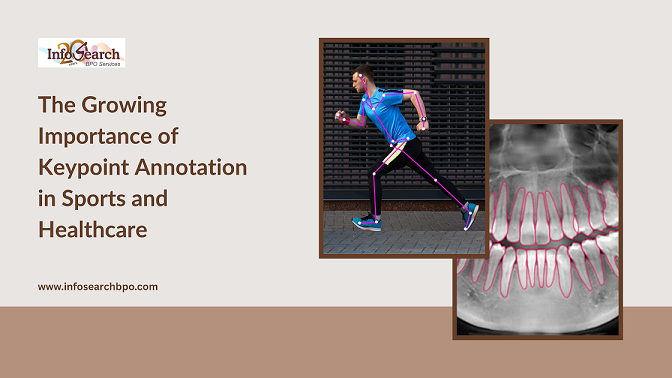
Infosearch is an exceptional provider of keypoint annotation for various industries, including sports and healthcare.
Industries which rely on movement analysis, body tracking and visual interpretation are experiencing a transformation in their use of Artificial Intelligence. There are numerous technologies that have contributed to this progress, and one of the most significant is computer vision. AI systems are being used and trained on the movement and behavior of the human body for a wide range of applications, from tracking athlete performance to monitoring rehabilitation progress to medical diagnostics.
Keypoint annotation is one of the most crucial methods that has helped achieve this capability.
Keypoint annotation assists machines in recognizing specific landmarks or points on a body, object or face. Whereas a human system would just see the person, an AI system learns to understand posture, gestures, movement, alignment and physical activity with amazing accuracy.
The sports and healthcare sectors have been particularly impacted by this technology, as knowledge of how the body and its movements interact is crucial in certain areas for performance, diagnosis, treatment and injury prevention.
Keypoint annotation is becoming increasingly integral to the creation of smarter AI-powered systems, as organizations invest more and more in intelligent analytics and automation.
What is Keypoint Annotation?
Keypoint annotation is a data labelling technique which involves adding points of interest to an object, face or body within an image or video. Read here about the keypoint annotation services of Infosearch.
Typically, these points will be linked to significant structures including: Eyes, Nose, Mouth, Shoulders, Elbows, Wrists, Hips, Knees, Ankles, Fingertips
AI systems can use these landmarks to calculate the position, orientation and movement of the subject.
Keypoint annotation is more than just an identifier of object location, it delivers detailed structural information that can be used to observe body posture and movement patterns by machines.
It is of great value in pose estimation, facial recognition, gesture tracking, motion analysis and biomechanics studies.
________________________________________
How Keypoint Annotation Works
Keypoint annotation is the process of marking a point in the image or selected frame with a label on a fixed point on the body or object within the image.
Data Collection
Data is collected using:
- Cameras
- Sports video footage
- Medical imaging systems
- Motion capture devices
- Surveillance systems
- Mobile devices
Annotation Guidelines
Clear directions are developed to ensure consistency.
Guidelines define:
The following are key points that need to be written down:
- Exact landmark placement
- Occlusion handling
- Movement tracking rules
- Annotation accuracy standards
Keypoint Labeling
Points are manually placed on the body landmarks or object features by annotators.
Skeleton Mapping
In several projects, the points are linked together in order to form a skeletal structure, which is used to represent the posture and movement of the body.
Quality Assurance
The consistency and accuracy of the annotations are checked by the reviewers.
AI Model Training
The data tagged with labels is used for training computer vision systems to estimate pose and recognize movement.
The AI system gradually comes to understand and automatically recognize body movement.
The importance of Keypoint Annotation in AI.
Modern Artificial Intelligence systems have come a long way from simply identifying objects and are now required to not only identify the objects but also track their movements and interactions.
With keypoint annotation, machines can:
- Track body movement
- Understand gestures
- Analyze posture
- Detect physical activity
- Monitor alignment
- Interpret facial expressions
With this increased level of knowledge, AI systems can take the next step from mere object detection to advanced behavioral and motion analysis.
This feature is particularly useful in fields where movement and accuracy are critical, and for this reason, keypoint annotation has emerged as a crucial aspect.
Keypoint Annotation in Sports – Why it matters?
AI-powered analytics are also being increasingly adopted in sports to boost the performance, strategy, and injury prevention of athletes. Infosearch provides the best keypoint annotations in sports.
Keypoint annotation enables users to take raw sports footage and turn it into performance insights.
Athlete Performance Analysis
Keypoint annotation is among the largest applications to sports specifically in the area of movement analysis.
AI systems can monitor an athlete:
- Running posture
- Jump mechanics
- Arm movement
- Body alignment
- Speed and acceleration
- Foot positioning
This enables coaches and analysts to analyze performance in great detail.
For instance, a sprinter’s posture and body length can be judged frame by frame to find ways to improve.
The exercise focuses on injury prevention and recovery.
Misaligned body movements can be a cause of sports injuries.
Keypoint annotation is used to mark abnormal posture, imbalance or excessive stress during the training process, which aids AI systems in identifying them.
This can assist coaches and medical staff:
Early detection of injury risks
- Monitor rehabilitation progress
- Improve movement correction
- Minimize the strain on joints and muscles
AI-powered motion analysis can also aid the monitoring of athletes who need to recover from injuries.
Tactical and Game Analysis
Keypoint annotation enables analysis of player positioning and tactical behaviour in a sport match.
AI systems can monitor:
- Player movement patterns
- Team formations
- Defensive positioning
- Passing sequences
- Reaction timing
These insights enable teams to make informed decisions about their strategies and enhance the overall performance of their game.
Enhanced Fan Engagement
AI-powered tracking systems are becoming more popular among broadcasters and sports media companies for improving the experience for viewers.
Keypoint annotation allows to use the following features:
- Real-time player tracking
- Motion overlays
- Performance statistics
- Replay analysis
- Interactive sports graphics
This offers enhanced and information-packed sports broadcasting experiences.
This is an application that covers various sports.
Keypoint annotation is now widely used in:
- Football
- Cricket
- Basketball
- Tennis
- Baseball
- Athletics
- Swimming
- Fitness training
- Martial arts
There’s movement tracking and performance analytics for each sport.
The Importance of Keypoint Annotation in Healthcare
Another industry that uses movement analysis is health care. Read here about keypoint annotation in healthcare.
Keypoint annotated AI systems are making diagnostics, rehabilitation, elderly care and patient monitoring easier.
Physical Rehabilitation and Therapy.
Movement monitoring is necessary for patients that are recovering from surgery, injuries, or neurological diseases.
AI systems can analyze with the help of keypoint annotation:
- Joint movement
- Walking patterns
- Posture correction
- Exercise performance
- Range of motion
This helps physiotherapists to get a better understanding of how well patients are recovering.
Gait Analysis
Gait Analysis is the study of walking and movement.
Using keypoint annotation, AI systems can detect abnormal movement patterns in the following diseases:
- Parkinson’s disease
- Stroke recovery
- Muscular disorders
- Balance problems
- Orthopedic conditions
Identification of movement abnormalities early in the treatment planning process will help optimize treatment.
Remote Patient Monitoring
Telemedicine and tele-health are emerging as a field with a tremendous expanse.
The AI systems with keypoint annotation can track patients remotely using mobile devices or cameras.
It enables health care providers to:
- Track rehabilitation exercises
- Monitor elderly patients
- Detect falls
- Assess movement quality
Give patients directions for virtual therapy
Accessibility and fewer hospital visits with remote monitoring.
Surgery and Medical Training.
Motion tracking systems train surgeons and other healthcare professionals in medical institutions.
Keypoint annotation can be used for analysis of:
- Hand positioning
- Surgical precision
- Procedure movements
- Instrument handling
AI-based training systems can give feedback and enhance skill development.
Elderly Care and Fall Detection
One of the key applications of healthcare AI is fall detection.
Keypoint annotation can support systems to recognize body posture changes and identify sudden falls among elderly people.
This will enhance patient safety and emergency response in assisted living facilities.
Facial Landmark Detection in Healthcare
Facial analysis is also being applied in healthcare, using keypoint annotation.
AI systems can be used to process facial landmarks to help with:
- Neurological assessments
- Emotional analysis
- Sleep monitoring
- Pain detection
- Facial paralysis diagnosis
Facial keypoint tracking is useful for diagnostic information.
The benefits of Keypoint Annotation are:
There are several reasons why keypoint annotation is important for AI systems.
Detailed Movement Understanding
It enables machines to interpret posture and body mechanics.
Improved Pose Estimation
High fidelity landmarks aid motion analysis accuracy.
Real-Time Tracking Capabilities
Movement can be dynamically monitored with AI systems.
Better Human-Computer Interaction
Works with gesture recognition and interactive systems.
Enhanced Predictive Analytics
Data on movement allows for the prediction of injuries, fatigue or abnormalities.
Keypoint Annotation Challenges
Although the use of keypoint annotation has its pros, it also has its cons.
Complex Human Movement
The range of body positions may differ greatly between activities and persons.
Occlusion Issues
Body parts may ‘disappear’ when moving.
Annotation Precision Requirements
AI model accuracy can be impacted by the placement of small errors.
Massive video data volumes.
In sports, healthcare systems, and other disciplines, frame-by-frame annotation is frequently helpful.
Need for Domain Expertise
Specific knowledge is needed for medical and biomechanical uses.
This makes it essential to keep the quality of the annotations high due to these difficulties.
Human Expertise and AI-Assisted Annotation
The use of AI-powered annotation tools can help to label keypoints more quickly as they can suggest landmarks and monitor motion across the frames.
But human intelligence is still necessary for:
- Correcting errors
- Handling complex poses
- Managing occlusions
- The ability to ensure medical or sports accuracy.
The human-in-the-loop workflows offer the most effective combination of effectiveness and quality.
The Future of Keypoint Annotation
AI and computer vision are constantly evolving, and so is the keypoint annotation.
Future trends include:
- Real-time pose estimation
- 3D skeletal tracking
- AI-assisted motion analysis
- Wearable sensor integration
- Virtual coaching systems
- Smart rehabilitation platforms
- Advanced sports analytics
In the realm of sports performance, these advancements will continue to shape the future of AI.
Final Thoughts
The technique of keypoint annotation is one of the most useful in the current field of computer vision, providing the means for machines to accurately interpret movement, posture and physical behavior.
In sports, it can be used to examine the performance of athletes, design training programs, reduce injuries, and develop strategies for games.
In the medical field, it is used for rehabilitation, gait analysis, patient monitoring, geriatrics, and medical diagnosis.
High-quality keypoint annotation will continue to be in demand as AI-driven movement analysis continues to evolve and improve.
To enable machines to understand human movement, they need to learn how the human body moves in detail.
Contact Infosearch for all your data annotations.




Recent Comments