Artificial Intelligence is transforming business, retail, medical diagnosis, and more. AI is driving innovations in personalized recommendations, voice-activated assistants, autonomous vehicles, credit card fraud prevention, and more. But behind any successful AI system is something a little less exciting but equally important: data annotation.
AI systems don’t know the world around them. They learn through examples. To train a computer to recognise a person, where a tumor is located in an MRI image, or to determine positive customer feedback in a review, massive amounts of data must first be categorised and labelled. This is called data annotation.
Put simply, data annotation converts raw data into training data that machine learning models can use. Without it, AI systems lack meaning, struggle to perform, and may not work in the real world.
As companies in every sector embark on their automation, machine learning, and generative AI journeys, they need reliable data annotation services to get there. Companies require access to high-quality data sources, efficient annotation processes, and domain expertise to develop robust smart systems.
In this comprehensive guide, we’ll walk you through all you need to know about data annotation – what it is, why it’s important, types of annotation, applications, industries, challenges, quality control, outsourcing, and the future of annotation in an AI-driven society.
What is Data Annotation?
Data annotation is the tagging of data to allow computers to learn from it and make decisions. This means attaching metadata, tags, labels, boundaries, links, or descriptions to raw data files.
In different projects, the data are:
- Images
- Videos
- Audio recordings
- Text documents
- Medical scans
- Satellite imagery
- 3D LiDAR point clouds
- Customer interactions
- Product catalogs
- Sensor data
For example:
- Enclosing a car in an image helps AI learn to recognise cars.
- Marking a sentence as positive or negative trains AI to detect sentiment.
- Drawing a box around a tumor on a computed tomography (CT) scan trains medical diagnosis, models.
- Labeling a person in several frames of a video trains object tracking.
After sufficient annotation, machine learning models can learn their way around similar patterns in new data.
Hence, annotation is often considered the fuel for artificial intelligence.
Main Types of Data Annotation
Various types of data annotation are needed for different AI uses. Here are a few of the more common types.
Image Annotation
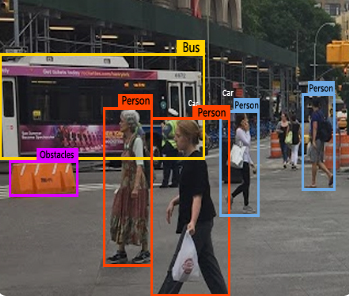 One of the most common types of data labeling is image annotation, as computer vision models require visual data. This process entails labeling features, objects, scenes, or patterns in an image to train AI algorithms to detect them.
It’s widely employed for product identification, medical diagnosis, quality control, surveillance, and self-driving cars. In the era of AI systems that need to be trained on millions of images, image annotation is a key service needed by companies that develop smart visual systems.
Bounding Box Annotation
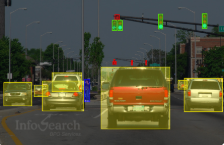 Bounding box annotation is a type of annotation where boxes are drawn around objects. It’s one of the quickest and easiest ways of annotating objects.
It is often applied to detect vehicles, human beings, animals, items, machines, and signs. It enables AI to learn about object position and size, and so is very useful in surveillance, autonomous vehicles, automated inventory, and analysis of supermarket shelves.
Polygon Annotation
 Polygon annotation is used to outline objects with a complex shape that can’t be defined by a rectangle. Annotators draw points around the perimeter of the object to outline it.
It’s commonly used in medical image analysis and agriculture, fashion retail, satellite images, and self-driving cars. This approach is more accurate than boxes and results in better models for boundary-sensitive tasks.
Semantic Segmentation
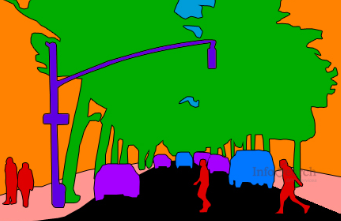 Semantic image segmentation labels each pixel in an image with a class. Rather than just object recognition, it allows the AI to understand what is in the image.
In a street scene, the pixels are identified as road, walkway, person, car, building, and sky. This is vital in autonomous vehicles, robots, satellite images, and medical diagnosis, where understanding the scene is crucial.
Instance Segmentation
Instance segmentation is a combination of object detection and segmentation, where each object is detected individually, even if they are from the same class.
This means that if there are five cars in a scene, it identifies each car separately, not as a group of cars. This is useful in a busy scene like a traffic scene, warehouse, store, or in sports analysis.
Keypoint Annotation
 Keypoint annotation involves identifying distinct points on an object, face, or human body. Landmarks or keypoints can be the eyes, nose, elbows, knees, fingertips, joints, and so on.
This annotation is used in facial recognition, gesture recognition, pose recognition, fitness technologies, augmented reality, and movement analysis in healthcare. It enables AI to recognise posture, structure, and movement, rather than just object recognition.
Video Annotation
Video annotation is a form of image annotation, but across several frames, enabling AI to interpret motion, actions, and object tracking in video.
It is widely applied in sports analytics, traffic management, customer behavior in retail, security and driverless vehicles. The dynamic nature of video, with motion and temporal events, adds complexity to annotation, which needs to be consistent across frames.
Examples
- Identifying players in sports video
- Monitoring traffic movement
- Detecting abnormal behavior in surveillance
- Detecting people’s movement for a driverless car
- Analyzing shopper activities
Text Annotation
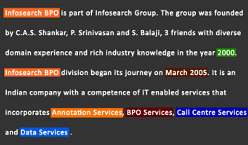 Text annotation is a critical part of Natural Language Processing (NLP). This includes tagging text to train computers to comprehend language, emotion, intention, entities, and context.
Text annotation is used to create chatbots, perform sentiment and email classification, build search engines, automate documents, and monitor social media. With the rise of conversational AI, text annotation has become a highly sought-after service in automation.
Its applications can be in chatbots, customer support automation, search engines, social listening tools, email classification, and legal document analysis.
Audio Annotation
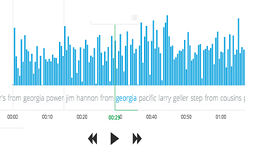 Audio annotation annotates audio clips, speech, conversations, and acoustic events to enable machines to interpret audio and speech.
It’s used in virtual assistants, voice-activated transcription, call centers, medical transcription, language learning apps, and IoT devices. This can include speech-to-text, speaker recognition, emotion recognition, and noise classification.
Tasks may include speech transcription, speaker diarization (who spoke when), emotion labeling, accent identification, wake-word detection, and sound event classification.
LiDAR and 3D Point Cloud Annotation
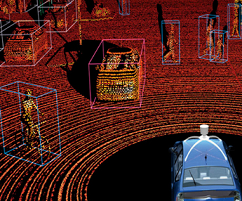 LiDAR and 3D point cloud annotation is a technique for labelling spatial data that is collected using sensors that are capable of measuring distances. It is a 3D representation of the world, rather than 2D.
It is used in self-driving cars and trucks, robotics, smart cities, construction and industrial automation. Annotators mark roads, cars, people, lanes, traffic, and buildings to help AI safely navigate through the world.
Annotators label these clouds using cuboids, 3D boxes, lane boundaries, road edges, and semantic classes.
Data annotation is used in many industries
Annotation services are no longer just for tech companies. Most businesses now have AI systems that require data annotation. Check Infosearch’s Industries to know which industries we cover for annotation services.
Annotation for Healthcare
 Healthcare AI for medical annotation is highly reliant on accurate data.
Examples include:
- Segmentation of tumors in scans
- X-ray diagnosis
- Clinical text extraction
- Pathology slide labeling
- Voice recognition for doctors
Due to the serious consequences of decisions, quality is paramount.
Annotations for the Automotive Industry
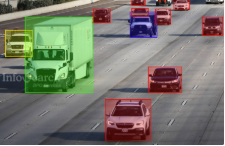 Annotation services are heavily used in the autonomous vehicle industry, particularly for self-driving and driver-assistance systems (ADAS). Autonomous vehicles require data to detect people, signs, traffic lights, lanes, cyclists, and other automobiles.
Car annotation services include image, video, and LiDAR labeling to train systems for better navigation, collision avoidance, driver safety, and real-time decision making.
Retail and E-commerce Annotation
 Annotation is used by retailers to enhance their shopping experience and backroom processes. Images are annotated for visual search, classification, recommendations, and stock management.
E-commerce businesses also use text annotation to analyse product reviews and automate chatbots. Video annotation is used in retail stores to track shoppers and arrange displays.
Finance Annotation
 Annotation is used by banks, insurance providers, and fintech firms to streamline documents and assess risk. Financial Annotation is used for processing claims, detecting fraud, automating customer support, and reviewing contracts.
Banks also use annotated data on transactions to detect fraud and enhance their compliance operations. It’s particularly important in terms of accuracy because of compliance requirements.
Agriculture Annotation
 Agriculture is becoming more and more advanced, with annotation helping drive smart farming. Satellite or drone images are tagged to identify soil and crop problems, such as disease, lack of water, weeds, and pests.
Annotation of agricultural data helps farmers predict crop yield, minimize waste, manage irrigation, and decide on planting with AI-driven precision farming.
Annotation for Logistics and Warehousing
 Annotation plays a role in speeding up, tracking, and automating logistics and warehouse operations. AI systems use annotated images and video for barcode scanning, sorting, and forklift safety and inventory management.
Video annotation is also used to assist robotics and worker safety in the warehouse. Data quality in logistics translates into quicker delivery and reduced costs.
Data Annotation for Sports Analytics
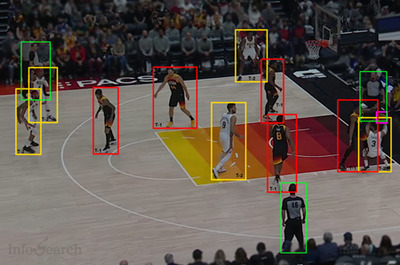 Annotation helps sports teams get insight into performance. They annotate video to monitor player, ball, and team positioning, and specific actions like passes, shots, or tackles.
Coaches apply this data for strategy, training optimization, injury risk reduction, and scouting. Television is also using annotated data to add to viewer engagement in real-time statistics and overlays.
Annotation For Security and Surveillance
 Annotated images and videos are vital for security surveillance to detect risks and irregularities. Trainers mark images and videos to identify faces, cars, crowd dynamics, boundary violations, and anomalies.
This helps companies enhance safety, secure restricted areas, automate alarms, and enhance incident management. Annotation is key to the development of smarter surveillance systems.
Human Annotation vs AI-Assisted Annotation
With growing demand, many companies question whether they should use human or artificial intelligence (AI) for annotation.
Human Annotation
Human annotation is still essential where context, nuance, and judgment are important.
Best for:
- Medical imaging
- Legal text
- Complex scenes
- Edge cases
- Quality review
Automated Annotation
AIs can rapidly label large, repetitive data sets.
Best for:
- High-volume image sets
- Straightforward classifications
- Early draft labels
- Rapid scaling projects
Human-in-the-Loop
The combination is now the norm. At Infosearch, we provide human-in-the-loop annotations for all our projects.
AI creates an initial labeling. Experts check, edit, and validate results.
This ensures accuracy and speed.
Why Companies Outsource Data Annotation?
Outsourcing data annotation is often preferred over in-house teams of data annotators. Enjoy these benefits and more at Infosearch.
Cost Efficiency – There are costs in hiring, training, setting up, managing, and software.
Faster Turnaround – Existing providers have staff and processes in place.
Scalability – Have 10 today and 100 tomorrow? With outsourcing, that’s possible.
Specialized Expertise – A good vendor can provide industry expertise.
Focus on Core Work – In-house engineering teams can work on building models rather than operationalizing data labeling.
Data Annotation is More Important than Ever
Too often, companies jump to develop AI without focusing on data. But it’s often more important to have good data than to build fancy algorithms.
An advanced AI system without high-quality training data is likely to be less accurate than simpler systems that are trained and tested on high-quality data.
Better Accuracy – An annotation provides the basis for machines to learn from. The better the annotations, the better the model.
Faster Development Cycles – Organized training data leads to less rework, retraining, or debugging.
Reduced Bias – Fair, unbiased, and consistent labeling helps avoid biased results.
Stronger Automation – Data labels are essential for chatbots, OCR, recommendation systems, fraud detection, and robotics.
Real-World Reliability – AI technologies must work in the real world. Annotation teaches models real-world use cases, corner cases and variations in the environment.
So, annotations turn raw data into smart machines.
Final Thoughts
Data annotation is one of the most crucial yet invisible elements of artificial intelligence. It is what allows machines to learn to see, read, hear, and comprehend.
Without quality annotation:
- Computer vision struggles
- NLP fails to understand language
- AI risks in medicine
- Self-driving vehicles are unsafe
- Business automation underperforms
Through proper annotation, AI solutions are smarter, safer, and faster.
If your company is building a machine learning or automation solution, or an intelligent product, the best place to start is not the model.
It is the data.
And the right approach to data annotation can be what makes AI applications work in the real world.




Recent Comments