gmap

Contact Us

We will reply within 12 business hours.

6 + 7 = ?
 

Your personal data shared with us through this form will only be used for the intended purpose. The data will be protected and will not be shared with any third party.

We don't outsource projects to other BPO centres. We execute all projects in house only.
Video Annotation

Video Annotation for AI & Machine Learning

Video Annotation Services for AI & Machine Learning

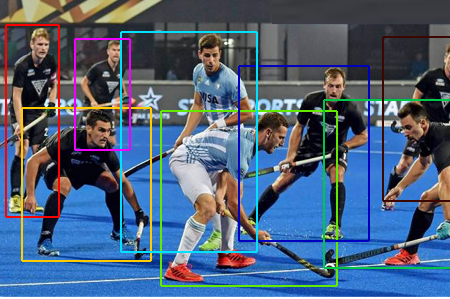
In simple terms annotating the content of the video refers video annotation. It doesn't mean transcribing the video content but to annotate required parameters in a video. For example in a foot ball game we may want to know the time of ball possession by host and opponent team, passes, losses etc. We can also track specific player by drawing bounding box for analysis purpose.

The annotation tool allows us to annotate required classes as we watch the video. The tool will have the option of pause, rewind, forward, slow motion etc. for better annotation results.

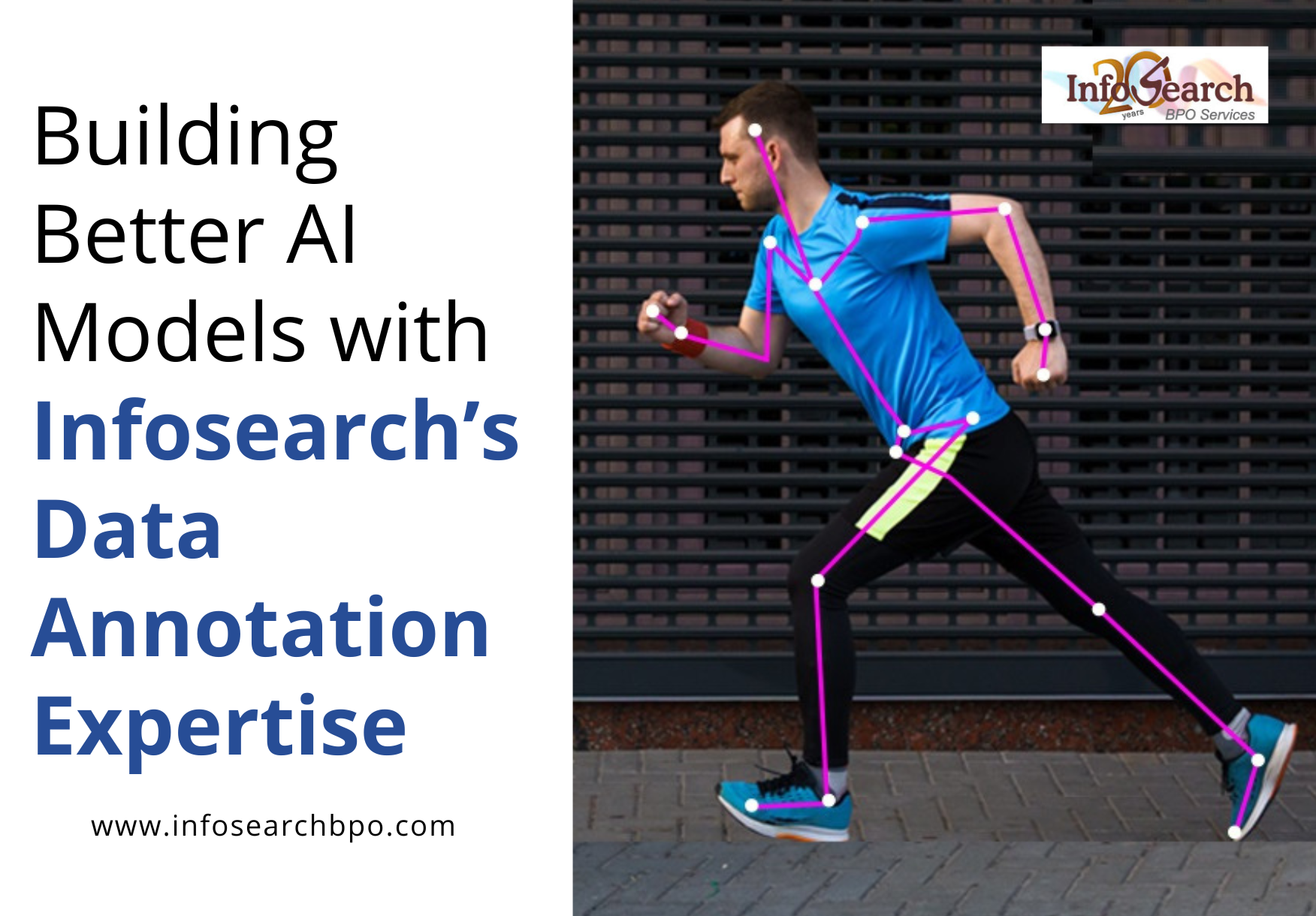
Video annotation is the process of detecting objects, localizing them and tracking human activities / poses from a video. At Infosearch, we approach video annotation services by the continuous frame method. We employ automation technologies to accurately streamline the video annotation process. The computer will examine pixels in corresponding frames and forecast how they will move throughout the film. As a result, the video's continuity and flow will be preserved.

Video Annotation For Machine Learning

Video annotations have vast applications in AI across industries. Some of them are,

Why to Outsource Video Annotation Services to Infosearch?

Video annotation can be a difficult task. The images in the video can have a variety of issues, such as inadequate lighting, obscured target items, or sections of the image that are unrecognisable to the naked eye. Our expert in-house team carefully considers how to represent these elements and gives you a high quality output. Through video annotation which generates high-quality training data, we create AI solutions with excellent precision and speed. Write to us right away with your requirements.

Video Annotation For Autonomous Vehicles

FAQs

Video annotation comprises a number of annotation types which include bounding boxes, polygon annotation, semantic segmentation, keypoint or landmark annotation, cuboid (3D) annotation, object tracking, action recognition, and event tagging. These are used to label objects, behaviors and interactions that move through frames on a video, to be used in training AI models.

Some of the important methods are frame-by-frame labeling, object tracking, temporal segmentation, motion tracking, multi-object labeling, event detection, and trajectory mapping. More sophisticated processing also includes interpolation, sensor fusion and human verification in order to provide accuracy and consistency across frames.

Applications in autonomous driving, surveillance and security, retail analytics, sports analysis, healthcare monitoring, robotics, smart cities, behavior analysis, and traffic management are some of the most common uses of video data labeling. It allows the AI models to learn how to move, how to interact and real-world situations.

Image annotation labels objects in one stationary frame whereas video annotation associates’ objects and events across time through multiple frames. Video annotation records the movement, interaction of objects and even a series of time, and is therefore more complicated yet is crucial in training AI systems that analyze dynamic environments.

Human-in-the-Loop (HITL) is also guaranteed to be accurate through automated annotation tools, and human review. Object movements are validated using human experts, which find solutions to ambiguities, track errors and complex human scenarios like occlusions or high-speed motion, which enhances the performance and reliability of models.

Consistency in the object ID is ensured through the application of state-of-the-art tracking algorithms, interpolation schemes and quality verification. Object continuity is checked by annotators frame-by-frame in order to ascertain that the identical object is identified at the same point throughout the video sequence to eliminate identity switching and enhance training precision.

We accept popular video formats like MP4, AVI, MOV, MKV and other video formats client specific. The annotated outputs may be provided in standard formats of machine learning such as JSON, XML, CSV, and custom schema that are compatible with popular AI and computer vision frameworks.

Object tracking entails the use of an object to track it through successive video frames with labeling and position remaining constant. It assists the AI models to learn the movement patterns, trajectories, and object behaviors in dynamic environments.

Yes. Scalability of annotation processes, automated pre-processing, distributed annotation teams and multi-stage quality assurance processes are used to handle large-scale video datasets to achieve uniform and accurate results on high-volume projects.

Action recognition annotation is used to label selected human or object actions in video streams, e.g. walking, running, driving or object-object interactions. This assists AI models to comprehend the activities and behavioral patterns to be utilized in activities such as surveillance, sports analytics and human-computer interaction.

Yes. It is possible to annotate video footage of drones and aerial footage to detect objects and track their movement and trace huge geographic features. Some of the areas where it is commonly used are infrastructure monitoring, traffic analysis, agriculture evaluation, mapping, and security surveillance.

Our Blogs

Our Blogs

close
infosearch BPO

Quick Business Enquiry


6 + 7 = ?


Success