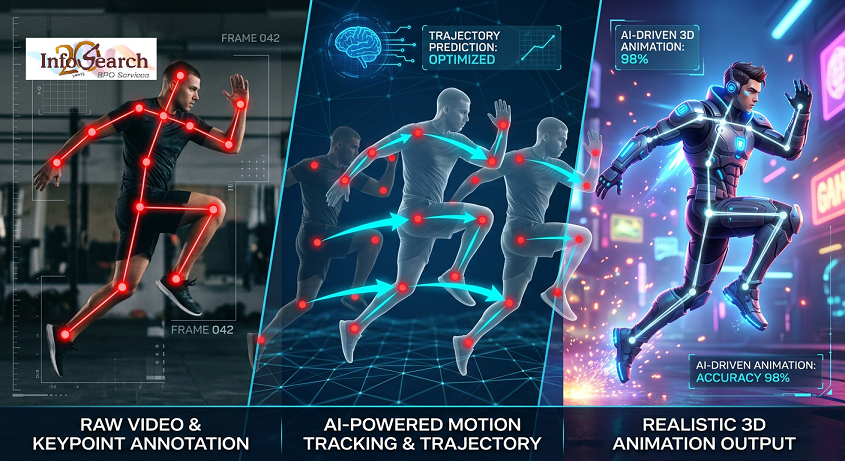
Infosearch’s keypoint annotation services helps gaming and animation industry in motion tracking.
Modern gaming and animation depend on motion tracking. Whether it is based on natural movements of characters to lifelike or virtual reality gaming, the realistic movement is determined by data precision. The heart of the technology is keypoint annotation a potent data labelling method which allows machines to comprehend the motions of bodies and objects in space.
This article will discuss how keypoint annotation is being used to make motion tracking better, as well as to make games and animation more lifelike and energized.
What Is Keypoint Annotation?
Keypoint annotation is an act of marking a certain set of coordinates (keypoint) on subjects or human body in an image or a video frame. Such points are usually representative of:
- Joints in human beings (shoulders, elbows, knees).
- Facial features (eyes, nose, mouth)
- Hand and finger joints
- Object articulation points
Mapping these coordinates at every frame, AI systems are learning the way movement occurs with time – thus, they are able to estimate the poses and track the motions correctly.
-
Allowing Realistic Character Animation.
Natural character movement is essential in the gaming and film industry to create an immersion. Keypoint annotation is the training of AI models in order to detect:
- Joint rotation
- Body posture
- Weight shifting
- Limb coordination
Motion capture data augmented with annotated keypoints are used to tune animation rigs in the studios that use tools such as Unreal Engine and Unity. This assists in getting rid of unnatural joint bending and robotic motion.
Output: Characters run dynamically, act in a way that is natural to physics, and reflect biomechanical facts on the real world.
-
Better VR AR Motion Accuracy.
Body tracking requires real-time VR and AR experiences. Annotated keypoints trained AI models can:
- Follow hand gestures to the point.
- Understand entire body movement.
- Identify micro expressions of avatars.
- Enhance responsiveness and latency.
Apps such as Meta Quest 3 are based on state-of-the-art tracking systems, which are based on pose estimation models that have been trained using huge keypoint datasets.
Result: Greater immersion of the game and more realistic avatars.
-
Improving Motion Capture (MoCAP) Processes.
Conventional motion capture is based on marker suits and camera rigs. Nonetheless, with AI-based keypoint detection one is able to:
- Marker less motion capture
- Automated data cleanup
- Faster retargeting to 3D rigs
- Less time of post-production.
The studios that have systems provided by such companies as Vicon start to incorporate AI-based pose models to simplify animation pipelines.
Output: Reduced costs of production and speed of animation.
-
Driving AI-Driven Procedural Animation.
Procedural animation systems are AI-focused in producing movements in real-time as opposed to depending on a collection of movement clips altogether.
Developers can develop systems that:
- Control real-time movement to terrain.
- Blend animation- Fluent training.
- Intelligently respond to actions of players.
- Simulation of the real-world physical constraints.
This is particularly strong in open-world games and sports games where the dynamic movement is necessary.
Outcome: Dumb and smart in-game characters.
-
Enhancement of Facial Animation and Capturing of Emotions.
Contemporary animation requires that it be emotionally expressive. Facial keypoint annotation makes it possible to:
- Lip-sync accuracy
- Minor eye movement and eyebrows tracking.
- Emotional articulations that are realistic.
- Mirroring of avatar faces in real-time.
Such games as The Last of Us Part II captured the cinematic realism with the help of high-fidelity facial capture technology that is based on the dense mapping the landmarks.
Conclusion: The characters are lively and believable on an emotional level.
The Importance of Keypoint Annotation of High Quality.
Motion tracking requires the quality of annotations. Bad labelling of joints may result in:
- Animation jitter
- Limb misalignment
- Glitchy physics behavior
- Unnatural motion of characters.
Good datasets can be used to guarantee that the models acquire the right biomechanics and spatial relations.
Wireless Motion Tracking of the Future.
Keypoint annotation is developing fast with:
- 3D pose estimation
- Multi-person tracking
- Real-time edge processing
- Auto-annotation tools with the help of AIs.
With the ongoing integration of gaming and animation with AI-powered systems, key-point annotation will still be a basis of providing hyper-realistic digital motion.
Contact Infosearch for annotation requirements
Since immersive VR up to cinematic narrative, key point annotation enhances significantly motion tracking in gaming and animation. With AI that learns precisely where the joints are located and their movement, the developers gain access to more animations, enhanced interaction, and unforgettable experiences of the players.
With the intelligence and automation of motion capture, annotated keypoints will keep on influencing the future of digital movement.
Outsource your keypoint annotation requirements to Infosearch. Contact us to discuss your queries.




Recent Comments