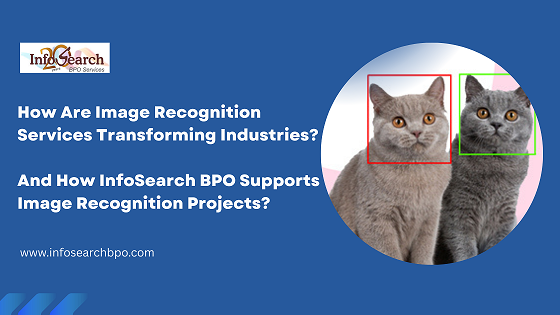
Artificial Intelligence (AI) isn’t just a research and futuristic topic anymore; it’s now a part of the current business landscape. One of its numerous applications, image recognition has become one of the most groundbreaking technologies, allowing machines to detect, categorize and understand images with high levels of accuracy. Whether you’re employing autonomous vehicles, conducting healthcare diagnostics, analyzing retail data, or automating industrial processes, image recognition is assisting with quicker decision-making, more efficiency, and new possibilities.
In 2026, image recognition is as sophisticated as ever. The development of deep learning, computer vision, cloud computing and edge AI has led to a dramatic increase in the accuracy and speed of visual analysis. Rather than just detecting objects via image recognition, businesses are now making use of it to automate inspections, monitor assets, improve customer experience, boost workplace safety, and make real-time decisions.
But the key ingredient to any successful image recognition system is the quality of annotated data. The development process of AI models requires image annotation, as they require accurate and reliable datasets to learn and recognize images.
Together, let’s dive into the world of image recognition services, their impact on industries in the years ahead, the technologies that are making this possible, and the importance of quality training data in intelligent computer vision systems.
What Are Image Recognition Services?
Image recognition services enable one to automatically analyze digital images to identify objects, people or text, patterns, or activities, using AI and computer vision algorithms.
Image recognition will allow machines to comprehend the content of an image similar to a human observer, rather than just enhancing or manipulating images as in traditional image processing.
These systems can be used to:
- Object detection
- Image classification
- Facial recognition
- Scene understanding
- Optical Character Recognition (OCR)
- Defect detection
- Medical image analysis
- Visual search
- Product recognition
The capabilities of AI-based image recognition systems are continually improving, with greater accuracy, scalability, and versatility in various applications.
How Does InfoSearch BPO Support Image Recognition Projects?
As organizations grow and use more AI projects, InfoSearch BPO will offer a complete data annotation service to help build image recognition models across various industries.
Its capabilities include:
• Image Annotation
• Bounding Box Annotation
• Polygon Annotation
• Semantic Segmentation
• Keypoint Annotation
• Video Annotation
• Text Annotation
• Audio Annotation
• LiDAR and Point Cloud Annotation
InfoSearch builds high-quality training sets for computer vision applications through the use of experts, Human in the Loop (HWITL) workflows, scalable delivery models and detailed quality assurance.
Its annotation services are suitable for automotive, healthcare, retail, agriculture, manufacturing, logistics, finance, security and sports analytics.
Why Image Recognition Matters in 2026?
The amount of visual data generated by organizations today is vast, and comes from smart phones, surveillance cameras, drones, satellites, medical imaging, industrial sensors, and connected IoT devices.
This type of information cannot be analyzed manually anymore.
Image recognition enables businesses to:
- Identify images from a large dataset
- Automate repetitive tasks
- Improve decision-making
- Detect anomalies faster
- Enhance customer experiences
- Reduce operational cost
- Improve workplace safety
With an increasing amount of data becoming critical to industries, image recognition is no longer a new technology, but it’s now a required business function.
Technologies Powering Modern Image Recognition
In 2026, several technologies are fueling the image recognition capabilities.
Deep Learning
These deep neural networks are able to detect complex visual patterns and continuously update the AI model by training.
Computer Vision
Computer vision algorithms enable machines to analyse visual data and understand the relationships between objects in visual images.
Edge AI
By being able to process images on local devices, applications like autonomous vehicles, manufacturing and surveillance can make real-time decisions without latency.
Cloud Computing
Cloud infrastructure allows companies to efficiently process large amounts of images, and provides the ability to easily deploy AI models in large numbers at scale.
High-Quality Data Annotation
One of the most important factors that affect the accuracy of the image recognition is well-annotated datasets.
Annotation techniques such as:
• Bounding boxes
• Polygon annotation
• Semantic segmentation
• Instance segmentation
• Keypoint annotation
Create AI systems that have the ability to identify objects reliably in various contexts.
The Impact of Image Recognition on Different Industries. Infosearch provides these services.
Healthcare
In Healthcare, image recognition is continually being used in a rapidly expanding way.
AI systems analyze:
• X-rays
• CT scans
• MRI images
• Ultrasound images
• Pathology slides
These systems help healthcare professionals to detect abnormalities, aid in early disease detection, and enhance diagnostic precision.
Image recognition also helps automate medical documentation and enhances clinical workflows.
Automotive
Image recognition plays a key role in Autonomous vehicles and Advanced Driver Assistance Systems (ADAS).
AI models identify:
• Vehicles
• Pedestrians
• Cyclists
• Traffic signs
• Lane markings
• Road obstacles
Together with LiDAR and radar data, image recognition helps to make driving safer and more driver-assisting.
Retail and Ecommerce
Retailers are employing image recognition to improve the customer experience whether online or in the store. Infosearch provides image recognition to both retail and e-commerce industries.
Applications include:
• Visual product search
• Automated inventory management
• Smart shelves
• Customer behavior analysis
• Checkout-free shopping
• Personalized product recommendations
The image recognition feature also enables ecommerce companies to classify products automatically and optimize catalog management.
Manufacturing
Computer vision is employed in automated quality inspection in manufacturing.
AI systems detect:
• Surface defects
• Assembly errors
• Missing components
• Product inconsistencies
• Equipment abnormalities
Automated inspection allows for more efficient production, decreased waste and operational costs.
Agriculture
Image recognition is becoming more and more important for precision agriculture.
Drones and smart cameras are used to supervise the fields as follows:
Drones and smart cameras analyze fields to monitor:
• Crop health
• Plant diseases
• Pest infestations
• Irrigation conditions
• Weed growth
The insights enable farmers to make better decisions and enhance yield and resource use.
Banking and Financial Services
Financial institutions use image recognition for:
• Identity verification
• Document processing
• Check processing
• Fraud detection
• Know Your Customer (KYC) verification
AI image analysis helps to speed up onboarding and enhance security and compliance.
Logistics and Warehousing
The automated image recognition systems help with Logistics and warehouse operations by monitoring
• Inventory
• Package sorting
• Barcode scanning
• Vehicle movement
• Worker safety
These are some of the benefits of these capabilities for the supply chain and for minimising manual errors.
Security and Surveillance
The image recognition technology of modern security surveillance systems is able to determine:
• Unauthorized access
• Suspicious activities
• Crowd movement
• Vehicle recognition
• License plates
• Object detection
Monitoring with AI helps to speed up the response to incidents while enhancing public safety.
Sports Analytics
Professional sports organizations increasingly use image recognition for:
• Player tracking
• Ball tracking
• Tactical analysis
• Performance evaluation
• Injury prevention
Coaches and analysts can use computer vision for real-time movement analysis and make data-driven decisions.
The importance of image annotation
The closer the images in the data set to the ones in the actual image, the more accurate the image recognition system will be.
Image Annotation is the process of annotating images with labels that enable AI models to learn about visual elements.
Common annotation methods include:
Bounding Box Annotation – Used for identifying and pinpointing objects in images.
Polygon Annotation – Labels irregular objects accurately.
Semantic Segmentation – Labels each pixel with a category.
Instance Segmentation – Differentiates objects in the same class.
Keypoint Annotation – Marks landmarks for pose estimation, facial recognition and gesture tracking.
Even the best AI models fail to provide reliable results if they’re not accurately annotated.
What Makes Businesses Outsource Image Recognition Data Preparation?
It takes great skills, time and quality control to prepare training datasets.
There are several benefits to outsourcing image annotation, which is why many organizations choose to outsource this task.
Access to Skilled Annotators – Professional annotation teams are aware of the industry-specific guidelines and complex requirements in labeling.
Scalability – If projects are large with millions of images, they can be completed efficiently with dedicated teams of annotators.
Human-in-the-Loop Validation – The expert annotators make sure that annotations are correct and process edge cases which may not be picked up by automated systems.
Cost Efficiency – By outsourcing, companies can lower recruitment and training expenses, as well as speed up the development of AI.
Emerging Trends in Image Recognition
The technology of image recognition is still very dynamic.
Key trends shaping 2026 include:
• Generative AI-assisted computer vision
• Real-time edge AI processing
• Multimodal AI combining text, images, audio, and video
• AI-powered robotics
• Smart manufacturing
• Intelligent healthcare diagnostics
• Digital twins
• Autonomous delivery systems
These innovations will drive even more need for accurate annotated data sets.
What is the future of image recognition?
With the evolution of AI models, the application of image recognition will continue to grow across industries and business applications.
The growing need for computer vision in automation and efficiency, as well as in safety and customer experience will drive the use of this technology in organizations more and more.
High quality data, powerful machine learning models, and ongoing improvements in annotation quality will drive the success of these efforts.
Companies that embrace robust image recognition solutions now will be poised to benefit from future advancements in AI.
Conclusion
In 2026, image recognition services are reshaping industries by empowering machines to analyze and understand visual data more accurately than ever before. In healthcare, computer vision is being used in autonomous driving to help automate processes and make better decisions, in retail and manufacturing to improve efficiency, in agriculture to increase yields, in logistics and supply chain to optimize routes, in finance to enhance fraud detection, and in security to enable smarter surveillance.
The key component of any successful image recognition system is the training data, which must be properly labeled. Effective image annotation is essential for enabling AI models to accurately identify objects, understand scenes, and operate in real-world conditions.
The power of image recognition is one of the most influential technologies driving intelligent automation in the future, as businesses continue to move towards digital transformation with AI. The organizations that integrate cutting-edge computer vision with robust data annotation capabilities will be better positioned to create innovative, accurate, and scalable AI solutions for the future.
Contact Infosearch for your image recognition services.




Recent Comments