
In the digital age, Artificial Intelligence is undoubtedly one of the most prominent technologies. These systems can process speech, identify objects, analyze documents, make recommendations, detect unusual activity, interpret medical images and even interact with people using natural language, with the help of artificial intelligence.
AI can sometimes feel like it’s a breeze to use due to these capabilities.
For every smart AI system, there’s a less-than-obvious element: data.
And behind much of the high-quality data used to train AI models is another important process—data annotation.
One of the things that people don’t usually think about with data annotations is that they are actually happening behind the scenes. Users use an AI application, but they don’t always see the thousands or millions of examples that the application sees as it learns what it knows.
Examples of cars, pedestrians, roads, buildings, and traffic signs are required for a computer vision model. One of the main requirements to develop a speech recognition system is to have audio with accurate transcriptions. The text that a natural language model requires must be structured, classified, or otherwise prepared for the purpose for which it is intended.
Put simply, data annotation provides AI with a “description” of the data it is reading, listening to, or analyzing.
Thus, annotation is one of the underrated assets in the AI toolbox.
So, what are Data Annotations?
Data annotation involves attaching labels or information to raw data to enable machine learning models to learn from them.
The data can consist of:
- Images
- Videos
- Audio
- Text
- Documents
- LiDAR data
- 3D point clouds
The kinds of annotations vary based on the purpose of training the AI system.
For instance, an image recognition model might require images that have objects in a bounding box. To build a system for human movement understanding, keypoints might be placed on points of the joints and body landmarks. For a speech recognition model, there might be a need to have audio recordings with accurate transcriptions.
The annotations essentially provide the AI model with examples of how humans interpret the data.
Imagine a picture of a car.
To a person, spotting the car might not be that hard. The form of a car is already known.
This understanding is not what a machine learning model starts with.
It must see lots of examples and learn patterns from them.
Once the thousands of images are correctly categorized as car images, the model can start to learn about visual attributes of cars.
Data annotation is one of the essential tasks in data.
Why AI Cannot Simply Learn from Raw Data?
The amount of raw data being produced by modern businesses is enormous.
Images and video are captured by a camera. Microphones record conversations. LiDAR data is gathered by vehicles. Customer behaviour data is generated on websites. Documents and transactions are created in a business.
One might think that AI systems could learn this information automatically simply by ingesting it.
In reality, it is a lot more complex.
For supervised machine learning, raw data is not always accompanied by the context necessary to accomplish the learning task.
The AI system needs to know which of the objects in a photograph is relevant, since there may be multiple objects in the image.
There can be more than one speaker, background noise, and sounds in an audio recording.
A video may depict a mix of motion among people, vehicles, and objects.
This information is structured by making annotations.
It can explain the model:
“This is a car.”
This is one of the pedestrians.
This section is the road.
This person is holding his/her hand up.
These are the words that are spoken in this audio.
That context is added to the training process.
There are different types of data annotation
Data annotation is not one particular technique. The kind of labeled data varies from one AI application to another. Infosearch provides these annotation services.
Image Annotation
Image Annotation: This is the task of segmenting and labelling objects or regions in an image.
It can include identifying:
- People
- Vehicles
- Products
- Animals
- Medical structures
- Buildings
- Industrial components
Many computer vision applications are based on image annotation.
Bounding Box Annotation
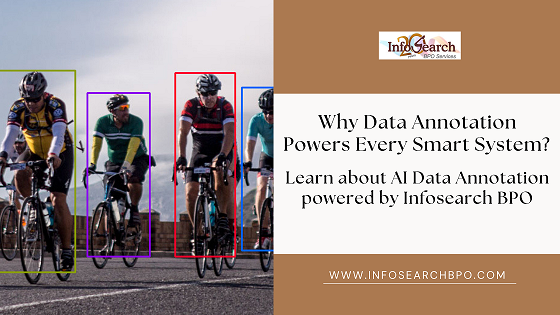
Bounding boxes consist of a rectangle that surrounds an object, used to identify it.
For instance, if you have an image with 3 cars in it, there will also be 3 bounding boxes in the image.
The technique is adopted in many object detection systems such as autonomous vehicles, retail, security, and robotics.
The goal is not just to be aware of the existence of a car. The annotation also provides the model with the position of the car in the image.
Polygon Annotation
A rectangle does not provide a good model for some objects.
Polygon annotation is available to enable the annotator to trace the shape of an object.
This can be beneficial for handling:
- Irregular objects
- Medical structures
- Agricultural features
- Buildings
- Vehicles
- Complex product shapes
More precise boundaries can give more detailed training data to computer vision systems.
Semantic Segmentation
Semantic Segmentation extends image annotation to the level of the individual pixels.
For instance, an autonomous driving image could have pixels that are marked like this:
- Road
- Vehicle
- Pedestrian
- Building
- Vegetation
- Sky
This will provide the AI with a comprehensive description of the visual scene.
Keypoint Annotation
Keypoint annotation is used to locate salient features of an object or human body.
These can include:
- Shoulders
- Elbows
- Wrists
- Hips
- Knees
- Ankles
- Facial landmarks
Keypoint annotation comes in handy for:
- Sports analytics
- Healthcare applications
- Gesture recognition
- Augmented Reality
- Virtual Reality
- Human pose estimation
It assists AI systems in recognizing movement and posture.
Video Annotation: Educating AI on movement.
Pictures capture a single second.
Videos represent the change over time.
This separation is highly relevant to AI capabilities that require the understanding of movement, such as video annotation.
Annotators can identify and track:
- People
- Vehicles
- Objects
- Actions
- Gestures
- Events
For instance, an autonomous driving system does not just have to be told that there is a pedestrian in the vicinity. It may also need to know of the pedestrian’s motion.
Likewise, the sports analytics system should be able to follow the athlete through a series of frames.
These applications require temporal information, which can be obtained from video annotation.
Audio Annotation Helps AI Understand Sound
AI systems can now better comprehend spoken language and other noises.
But audio data needs to be structured appropriately for machine learning.
The following are examples of information that can be integrated into audio annotation:
- Speech transcription
- Speaker identification
- Emotion labeling
- Sound classification
- Timestamping
- Language identification
This technology can be used to enable applications like:
- Voice assistants
- Call centre automation
- Speech recognition
- Audio search
- Customer interaction analysis
Customer conversations can be accurately transcribed, for instance, to train systems to recognise words and understand accents, speech patterns, and conversation context.
Text annotations
Natural language processing systems should be able to comprehend more than just single words.
With text annotation, you can locate information like:
- Names
- Locations
- Organisations
- Topics
- Sentiment
- Intent
- Keywords
- Relationships between entities
Let’s take a customer message as an example:
I got the wrong product and would like a replacement.
The customer’s intent may be identified through a text annotation process as some sort of replacement request.
The structured information can be utilized for training AI systems in customer service, document processing, search, recommendation systems, and virtual assistants.
LiDAR and 3D Point Cloud Annotation
Two-dimensional data is not always enough as AI takes its place in the real world.
The use of 3D information is growing in autonomous vehicles, robots, drones, and mapping systems.
Using lidar and 3D point cloud annotation, millions of points can be captured that represent the surrounding environment.
Point cloud annotation can recognize:
- Vehicles
- Pedestrians
- Roads
- Buildings
- Structures
- Equipment
- Other environmental features
Three-dimensional bounding boxes, semantic segmentation, instance segmentation, and object tracking can all be used to prepare LiDAR datasets.
Such information can be used to guide AI systems to determine both the identity of an object and its position in three-dimensional space.
Data Annotation Is Behind Autonomous Driving
High-quality annotation is crucial, especially with autonomous vehicles.
There are some systems that a self-driving system must be able to learn and see:
- Cars
- Trucks
- Pedestrians
- Cyclists
- Traffic lights
- Traffic signs
- Lane markings
- Roads
- Buildings
- Obstacles
It may also require knowledge of the movement of such objects.
This would need tremendous training data.
Images, video, LiDAR, radar, as well as other sensor data can all play a role in the creation of autonomous systems.
The labels given to the data in Annotation enable machine learning models to learn from them.
If the training data are representative of real-world scenarios, the model will be able to identify various situations.
Data Annotation is revolutionizing Healthcare AI technology
AI has also emerged as a key element in medical imaging and healthcare technology.
Computer vision models can be used to analyse medical images and identify important structures to be further analysed or structures of interest to be targeted by the modality.
Depending on the application, annotation can be achieved by labelling:
- Organs
- Tissues
- Anatomical structures
- Lesions
The other regions of interest are:
It is important to accurately annotate this kind of data due to the fact that the boundaries might differ slightly between different pieces of data, and it can have an impact on the usefulness of the training data.
In healthcare-related annotation, where context is key, human expertise is indispensable, and AI-generated results must not replace the expertise of healthcare professionals.
Agriculture that is smarter is in the process of helping.
Another sector that gains from AI and computer vision is agriculture.
Technology, such as drones, satellites, and camera imagery, can obtain extensive agricultural imagery.
Annotated datasets can be used to train AI models that can help identify:
- Crops
- Weeds
- Plant diseases
- Fruits
- Flowers
- Field boundaries
- Irrigation areas
For instance, an agricultural AI system can use drone photography to determine which sections of a field are showing signs of unhealthy crops.
Polynomial or segmentation annotation techniques can be used to enable crop discrimination from the surrounding vegetation and soil in models.
This can help to increase data-driven farming.
Visual data is critical for retail and e-commerce
In the retail sector, AI is becoming a more popular tool for comprehending products and customer behavior.
These are some of the uses of computer vision applications:
- Product recognition
- Visual search
- Inventory monitoring
- Shelf analysis
- Virtual try-on
- Customer behaviour analysis
AI can be used to identify products in images, which may be necessary for an e-commerce platform.
Customers can upload an image to a visual search system to locate similar products visually.
These abilities depend on training data being provided with the products and visual features correctly labelled.
That basis can be provided by annotation.
What is the point of data annotation and sports analytics?
Sports annotation is another big area of computer vision application.
AI systems can monitor the following using video:
- Players
- Ball movement
- Body position
- Speed
- Direction
- Actions
- Tactical patterns
The localization of body landmarks through keypoint annotation and tracking of objects and players over time can be facilitated by using video annotation.
This data can be used for performance analysis, coaching aids, scouting, broadcasting, and fans.
The technology can convert unstructured sports footage into structured data, which can be analysed by AI systems.
Safeguarding and Surveillance Use Cases
AI-driven surveillance cameras can process video feeds to detect objects, movements, or unusual activities.
Annotated datasets can be used to train systems to recognize:
- People
- Vehicles
- Restricted areas
- Objects
- Specific activities
Video annotation can also be used to mark specific actions or sequences, which can help with event detection.
But surveillance technologies have serious privacy concerns, questions of good practice, data security, and human control.
Technical knowledge of how to do something does not necessarily mean it should be done without proper precautions.
Responsible AI is not just a technical matter, but also an ethical one.
The quality of the annotations is important
Since data annotation is the base of an AI model, the quality of the annotations is one of the most important factors impacting the base of the model.
An error in writing the annotation can look insignificant.
However, if the same error occurs thousands or millions of times, it can affect the learning of the model.
Some of the common quality problems are:
- Incorrect labels
- Missing annotations
- Inconsistent boundaries
- Duplicate labels
- Poor object tracking
- Ambiguous classifications
Quality control is thus required in the annotation process.
This may involve:
- Clear annotation guidelines
- Annotator training
- Sample reviews
- Multiple levels of quality checks
- Error analysis
- Continuous feedback
The aim is not just about big data sets.
It is to develop trustworthy data sets.
Why Human Expertise Still Matters?
As AI annotation tools proliferate, it might seem like a good idea to eventually get rid of human annotators.
The truth is more complicated.
With AI-assisted annotation, many common objects can be automatically identified to generate preliminary labels. This can help to reduce repetitive manual labour.
However, there are still challenging scenarios that need human judgement.
Examples include:
- Unusual objects
- Poor-quality images
- Occluded objects
- Ambiguous scenes
- Complex human activities
- Unclear speech
- Domain-specific terminology
That’s why the Human-in-the-Loop model is becoming more significant.
AI will do repetitive tasks.
Humans handle complexity.
The mix can lead to a quality and scalable workflow.
AI is also assisting annotators
Data annotation isn’t just to help AI systems.
AI is also now starting to assist the individuals who annotate data.
Modern annotation workflows can use AI to:
- Pre-label images
- Follow objects through video
- Suggest classifications
- Detect possible errors
- Prioritise difficult examples
- Automate repetitive tasks
Instead of having to build up a dataset from scratch, the annotator can consult the suggestions.
This generates a strong cycle of feedback.
Human beings → AI computers → Human beings → Better AI computers
High-quality corrections by humans. Those corrections can help to make better models. Better models can make better predictions for future annotation tasks.
This can be a continual improvement in the annotation process.
The Hidden Cost of Poor Training Data
Businesses tend to invest a lot of money in AI, and they tend to care about the model.
They may ask:
Which algorithm should we use?
So, what should we use for the AI platform?
What magnitude of infrastructure do we need?
These are crucial questions.
But another question has to be given equal consideration:
Is the learning data satisfactory?
Even if the data is poor, it can still create an incorrect result with a complex AI model.
It can be difficult to have labels that are incorrect, not enough diversity, not enough examples, or inconsistent annotation.
Where a lot of the time in AI projects, improving the data is as crucial as improving the model itself.
That is why it’s time to pay more attention to data annotation.
Data Diversity Matters
AI models have to see a diverse set of real-world scenarios.
Suppose the object recognition model is all learned from clear images during daylight.
It will work well when subjected to those circumstances.
What if the same object is presented, however:
- At night
- In rain
- In fog
- From a different angle
- Partially hidden
- At a greater distance
- In a crowded environment
A good data set should contain significant variation in data that is relevant.
Therefore, annotation teams must collaborate with a variety of datasets representative of the potential conditions that the AI system will encounter.
This is especially crucial for autonomous driving, robotics, surveillance, agriculture, and other practical implementations of AI.
Data Annotation at Scale
Large amounts of labeled examples might be required for modern AI companies.
Internal project management for such projects can be a major resource-intensive undertaking.
Large annotation teams may need to be recruited, trained, supervised, and managed in the business, while the quality of the annotations must be consistent.
Partnering with outsourcing can offer access to specialized teams and resources that can be scaled.
A professional annotation partner can assist companies with massive amounts of:
- Image annotation
- Video annotation
- Text annotation
- Audio annotation
- LiDAR annotation
Add tags to the 3D point cloud data.
This enables AI companies to dedicate their own manpower to building AI models and focus on innovation of their products while outsourcing data preparation tasks.
AI Data Annotation is powered by InfoSearch BPO.
InfoSearch BPO offers several types of data annotation services, including but not limited to:
- Image Annotation
- Bounding Box Annotation
- Polygon Annotation
- Semantic Segmentation
- Instance Segmentation
- Keypoint Annotation
- Video Annotation
- Text Annotation
- Audio Annotation
- Autonomous
- LiDAR and 3D Point Cloud Annotation
These services can help power AI solutions in industries ranging from automotive, retail and ecommerce, finance, agriculture, logistics, sports, security and surveillance, to health, and beyond.
As businesses deal with large volumes of data, scalable annotation resources can be beneficial for managing the increasing demands for training data.
Using trained human annotators, structured workflows, quality control, and technology-assisted processes can aid in the development of more consistent and machine-ready datasets.
The future of data annotation
With the advancement of AI technology, data annotation will likely change.
Instead of manual processes, there will be more and more AI-assisted workflows for annotation.
For future annotation environments, more trust in:
- Automated pre-labeling
- Active learning
- Intelligent quality checks
- Synthetic data
- Multi-modal annotation
- Human-in-the-loop workflows
- Automated object tracking
- Real-time data processing
Meanwhile, specialised annotation will assume greater significance.
For highly technical environments, AI systems could need specific datasets and meticulous standards for annotation.
The future isn’t just a matter of annotating more data.
It’s about making data better, smarter, more representative, and more useful.
Conclusion
While the spotlight is on AI, it is data that provides AI with the capacity to learn.
Much of this data has annotation behind it.
Whether creating labels for autonomous driving systems, annotating objects in retail images, or interpreting 3D environments, objects and events can be annotated to provide the structure that enables AI models to learn from the world around them.
The need for high-quality and representative training data will continue to grow as AI becomes more sophisticated in its application.
Automated annotation technologies will increasingly be combined with human experts in the future. While people will be doing the things that require judgement, context, quality assurance, and domain expertise, AI will get repetitive tasks done.
Data Annotation can work in the background without any visible effect, yet it has an impact everywhere. All intelligent systems must have something to learn from, and high-quality annotated data is a starting point for intelligence.
If you’re developing the next set of AI applications for your business, then it’s not just a job to be done. It is an investment in the quality, accuracy, and capacity of the AI system.
Contact Infosearch for your data annotation services.




Recent Comments